> ## Documentation Index
> Fetch the complete documentation index at: https://docs.forge.ai/llms.txt
> Use this file to discover all available pages before exploring further.
# Inventory
> View your complete AI estate across products, agents, workloads, identities, and AI-native assets.
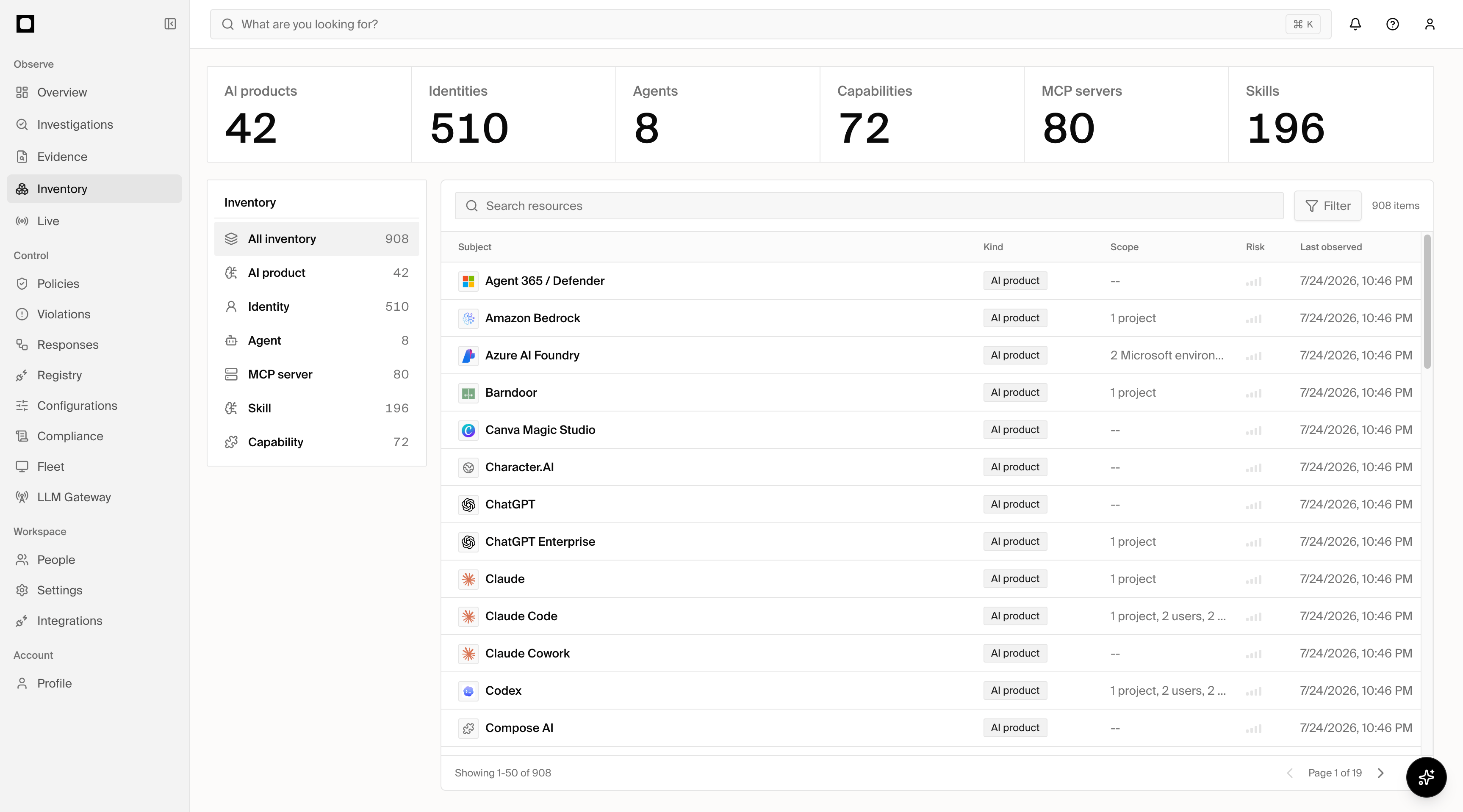 Inventory is the system of record for your organization's AI estate. Forge
connects data from SaaS applications, cloud platforms, endpoints, networks, and
code repositories to build one comprehensive view of the AI used across the
company.
Use Inventory to understand both the organization at large and each person's
individual AI setup.
## What it includes
Inventory brings together:
* **AI products** used across the organization, including SaaS applications,
coding tools, model platforms, and other AI-enabled software.
* **Agents and workloads** running on endpoints, in cloud environments, and
through connected applications.
* **Identities** using those products, agents, and workloads.
* **MCP servers and skills** available to users and agents.
* **Capabilities** exposed by connected agents and tools.
* **AI-native artifacts** such as plugins, memories, hooks, configuration
files, and other runtime or development assets when supported by the source.
Forge reconciles observations from multiple sources into shared inventory
records so the same product, agent, identity, or asset is not understood in
isolation.
## Connected sources
| Source | What it contributes |
| ----------------- | ---------------------------------------------------------------------- |
| SaaS applications | Products, accounts, users, agents, activity, and platform metadata. |
| Cloud platforms | Hosted models, AI services, agents, workloads, and related resources. |
| Endpoints | Installed tools, local agents, configurations, MCP servers, and usage. |
| Networks | AI services and destinations observed in network activity. |
| Repositories | Agent definitions, configurations, plugins, hooks, and AI artifacts. |
The combined view is more complete than any individual integration: cloud and
SaaS sources describe managed services, while endpoint, network, and repository
sources help reveal local, custom, and otherwise unmanaged AI.
## Collection and refresh
Where supported, Forge starts an initial collection automatically after you
configure a source or import its endpoints. Connected sources are then
refreshed on a schedule so Inventory stays current without requiring manual
scans.
For large endpoint fleets, collection progresses across the full fleet over
time rather than silently skipping devices. Each source shows when it last
refreshed and whether the current collection is complete, still in progress,
partial, or unsuccessful. Existing results remain available while Forge works
through the remaining coverage.
Fresh observations take precedence over older records without erasing their
history. Forge reconciles identities and devices seen through sources such as
Microsoft Entra ID, Intune, Jamf Pro, CrowdStrike, SentinelOne, network
integrations, and Forge for devices into a current view, while preserving the
sources behind each record.
## Explore your estate
The Inventory summary shows the number of AI products, identities, agents,
capabilities, MCP servers, and skills Forge has discovered. Select a kind or
search across all inventory to narrow the estate.
Open an inventory record to review:
* Where and when Forge observed it.
* The identities that use or interact with it.
* Related products, agents, workloads, and AI-native assets.
* Detected configurations and source-specific details.
* Risk factors associated with the record or its setup.
### MCP and skill risk
MCP server and skill records can include a risk tier, summary, affected tools
or package content, supporting evidence, and recommended next steps. When
observed, Forge also shows referenced URLs and package names or versions so a
reviewer can understand the dependencies and destinations involved.
Inventory shows risk in the context of the asset and the identities using it.
Registry requests show the same available risk information at the approval
decision. Findings attributed directly to one MCP server, tool, or skill stay
with that record; risks that depend on a combination of assets live in
**Investigations**. Related records link to one another so reviewers can move
from discovery to approval and investigation without recreating the context.
## Identity setups
Inventory connects identities to the AI they use. Open an identity to understand
that person's unique environment, including their products, agents, MCP
servers, skills, plugins, memories, hooks, and configurations where available.
This makes it possible to compare the organization-wide estate with the actual
setup of an individual user without treating every source as a separate silo.
## Shadow AI
Inventory highlights AI products and assets that are unmanaged, unapproved, or
outside the organization's expected setup. This includes obvious shadow AI,
such as an unapproved application, as well as less visible artifacts such as a
local MCP server, plugin, hook, or agent configuration.
Review the affected identities and detected configuration to understand the
exposure. From there, move usage to an approved option, bring the asset under
management, restrict it with a supported control, or remove it from the
environment.
Inventory is the system of record for your organization's AI estate. Forge
connects data from SaaS applications, cloud platforms, endpoints, networks, and
code repositories to build one comprehensive view of the AI used across the
company.
Use Inventory to understand both the organization at large and each person's
individual AI setup.
## What it includes
Inventory brings together:
* **AI products** used across the organization, including SaaS applications,
coding tools, model platforms, and other AI-enabled software.
* **Agents and workloads** running on endpoints, in cloud environments, and
through connected applications.
* **Identities** using those products, agents, and workloads.
* **MCP servers and skills** available to users and agents.
* **Capabilities** exposed by connected agents and tools.
* **AI-native artifacts** such as plugins, memories, hooks, configuration
files, and other runtime or development assets when supported by the source.
Forge reconciles observations from multiple sources into shared inventory
records so the same product, agent, identity, or asset is not understood in
isolation.
## Connected sources
| Source | What it contributes |
| ----------------- | ---------------------------------------------------------------------- |
| SaaS applications | Products, accounts, users, agents, activity, and platform metadata. |
| Cloud platforms | Hosted models, AI services, agents, workloads, and related resources. |
| Endpoints | Installed tools, local agents, configurations, MCP servers, and usage. |
| Networks | AI services and destinations observed in network activity. |
| Repositories | Agent definitions, configurations, plugins, hooks, and AI artifacts. |
The combined view is more complete than any individual integration: cloud and
SaaS sources describe managed services, while endpoint, network, and repository
sources help reveal local, custom, and otherwise unmanaged AI.
## Collection and refresh
Where supported, Forge starts an initial collection automatically after you
configure a source or import its endpoints. Connected sources are then
refreshed on a schedule so Inventory stays current without requiring manual
scans.
For large endpoint fleets, collection progresses across the full fleet over
time rather than silently skipping devices. Each source shows when it last
refreshed and whether the current collection is complete, still in progress,
partial, or unsuccessful. Existing results remain available while Forge works
through the remaining coverage.
Fresh observations take precedence over older records without erasing their
history. Forge reconciles identities and devices seen through sources such as
Microsoft Entra ID, Intune, Jamf Pro, CrowdStrike, SentinelOne, network
integrations, and Forge for devices into a current view, while preserving the
sources behind each record.
## Explore your estate
The Inventory summary shows the number of AI products, identities, agents,
capabilities, MCP servers, and skills Forge has discovered. Select a kind or
search across all inventory to narrow the estate.
Open an inventory record to review:
* Where and when Forge observed it.
* The identities that use or interact with it.
* Related products, agents, workloads, and AI-native assets.
* Detected configurations and source-specific details.
* Risk factors associated with the record or its setup.
### MCP and skill risk
MCP server and skill records can include a risk tier, summary, affected tools
or package content, supporting evidence, and recommended next steps. When
observed, Forge also shows referenced URLs and package names or versions so a
reviewer can understand the dependencies and destinations involved.
Inventory shows risk in the context of the asset and the identities using it.
Registry requests show the same available risk information at the approval
decision. Findings attributed directly to one MCP server, tool, or skill stay
with that record; risks that depend on a combination of assets live in
**Investigations**. Related records link to one another so reviewers can move
from discovery to approval and investigation without recreating the context.
## Identity setups
Inventory connects identities to the AI they use. Open an identity to understand
that person's unique environment, including their products, agents, MCP
servers, skills, plugins, memories, hooks, and configurations where available.
This makes it possible to compare the organization-wide estate with the actual
setup of an individual user without treating every source as a separate silo.
## Shadow AI
Inventory highlights AI products and assets that are unmanaged, unapproved, or
outside the organization's expected setup. This includes obvious shadow AI,
such as an unapproved application, as well as less visible artifacts such as a
local MCP server, plugin, hook, or agent configuration.
Review the affected identities and detected configuration to understand the
exposure. From there, move usage to an approved option, bring the asset under
management, restrict it with a supported control, or remove it from the
environment.