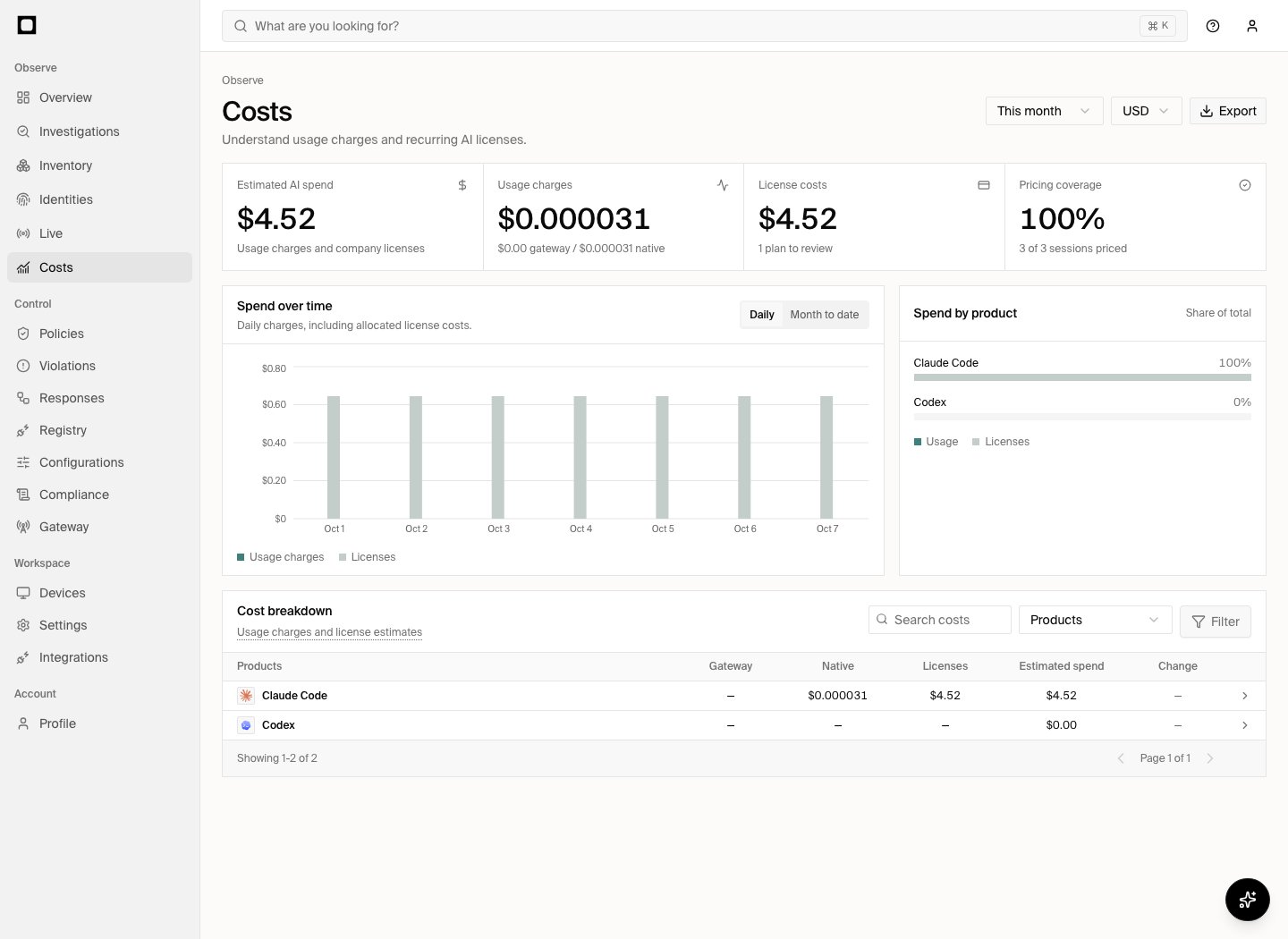
Open Observe > Costs to review AI spending across your organization. Gateway Spend continues to show gateway traffic alone.
Costs with usage charges, license estimates, daily bars, and a product breakdown
Use Daily or Month to date to view usage charges and allocated licenses. The cost breakdown uses the same compact table as Gateway Spend. Search, group, and filter the report there; use Export for a summary or individual records. Hover or keyboard-focus the dotted-underlined breakdown subtitle for estimate semantics and excluded costs. The change column compares the selected dates with the immediately preceding period of the same length. A dash means no comparison is available.

Understand the totals

The report separates gateway usage, direct usage charges, and AI licenses. Gateway charges use the originating AI product when known, or the model provider’s catalog product otherwise. MCP traffic is excluded from AI cost coverage. Live sessions use the same catalog product identities. Violations identify the provider for the violating request when its request identity is available, while preserving a known originating application. Gateway Spend continues to group charges by provider and model. Product details and identity usage include every observed provider in a session without multiplying the organization’s session total. New gateway activity refreshes Inventory through the existing background projection. Cloud gateway traffic uses the billed cloud product: Amazon Bedrock, Azure OpenAI, Azure AI Foundry, or Vertex AI. Using an Anthropic model through Bedrock therefore attributes its charge to Amazon Bedrock. A compatible custom endpoint is not identified as OpenAI or Anthropic from its wire protocol alone. Daily bars allocate subscriptions over their service period. Selecting Month to date shows the accumulated amount. Product rows show the same breakdown. All filters apply to the metrics, charts, product ranking, and table. Choose a date range, search, or filter by product, person, team, provider, or cost type. Group the table by product, team, person, provider, or billing account. Report dates use UTC. Currencies are reported separately. Forge does not convert a foreign-currency subscription into your selected currency.
These estimates are not invoices. Taxes, negotiated discounts, regional pricing, and usage that Forge did not observe can change the billed amount.

Direct usage

Direct usage is AI usage observed outside a gateway. Forge prefers counters reported by a connected provider or developer tool. Supported Claude Code and Codex records include input, output, and cache tokens. Supported captured Anthropic Messages and Codex Responses traffic can also supply usage. Replayed observations and cumulative snapshots do not add the same usage twice. Pricing uses the observed model and a versioned model-price catalog. Provider charges take precedence when available. A missing model or incomplete record remains unpriced. Cursor observations without reported usage are unpriced; visible conversation text does not establish the complete billable context. MCP tool traffic is excluded. Subscription-included inference is usage value at an equivalent API price. It is not added to usage charges. Usage with unknown billing ownership stays separate until ownership is established. Pricing coverage measures eligible observed sessions with a known pricing basis. It does not measure estimate accuracy. Use its link to review sessions that need a price. Live keeps its own selected time range.

AI license estimates

Inventory observations identify candidate AI products and their users. A detected application alone does not establish a paid subscription, plan, payer, or assigned seat. Open a product and expand Licenses and pricing to review candidates. An organization administrator can select a plan, confirm the payer, and correct the price, currency, billing interval, quantity, and effective service period. Only confirmed company-paid estimates contribute to license spend. Search people or billing accounts and filter by Needs review, Confirmed, or Inactive. The license table loads 50 assignments per page. Select a plan or Confirm in a row to edit one assignment. To update many people, select rows and choose Set pricing. Select the page checkbox, then Select all matching to include every matching assignment across pages. Review the count on the save button before applying the price, payer, and service dates. Seat counts and billing accounts are preserved. Use Needs review to confirm new assignments without changing previously confirmed prices. These updates affect existing assignments; newly detected licenses still require confirmation. Published plan prices retain their source and collection date. Quote-only, bundled, promotional, or ambiguous prices remain unknown. Ordinary software licenses are excluded. You can supply your AI-specific contract price instead. Microsoft 365 Copilot’s catalog includes standalone AI add-on baselines: Business at USD 252 per user/year or USD 25.20 per user/month, and Microsoft 365 Copilot at USD 360 per user/year. These exclude the prerequisite Microsoft 365 suite. Use a custom price for a negotiated or promotional rate. Shared subscriptions are counted once when their account identity is known. Installing the same AI product on several devices does not create several licenses. Unknown account relationships are not assumed to share a license. Annual prices use the annual total, allocated over the annual service period. Changing a future price preserves earlier service periods. Use Advanced > Billing account to identify a shared subscription explicitly.

Review and export

Open a product row for its breakdown and license estimates. Use the pricing coverage link to review sessions that need a price. Export the summary or underlying records as separate CSVs using the current report filters. License review applies to products with supported subscription plans. API usage alone does not imply a paid subscription.