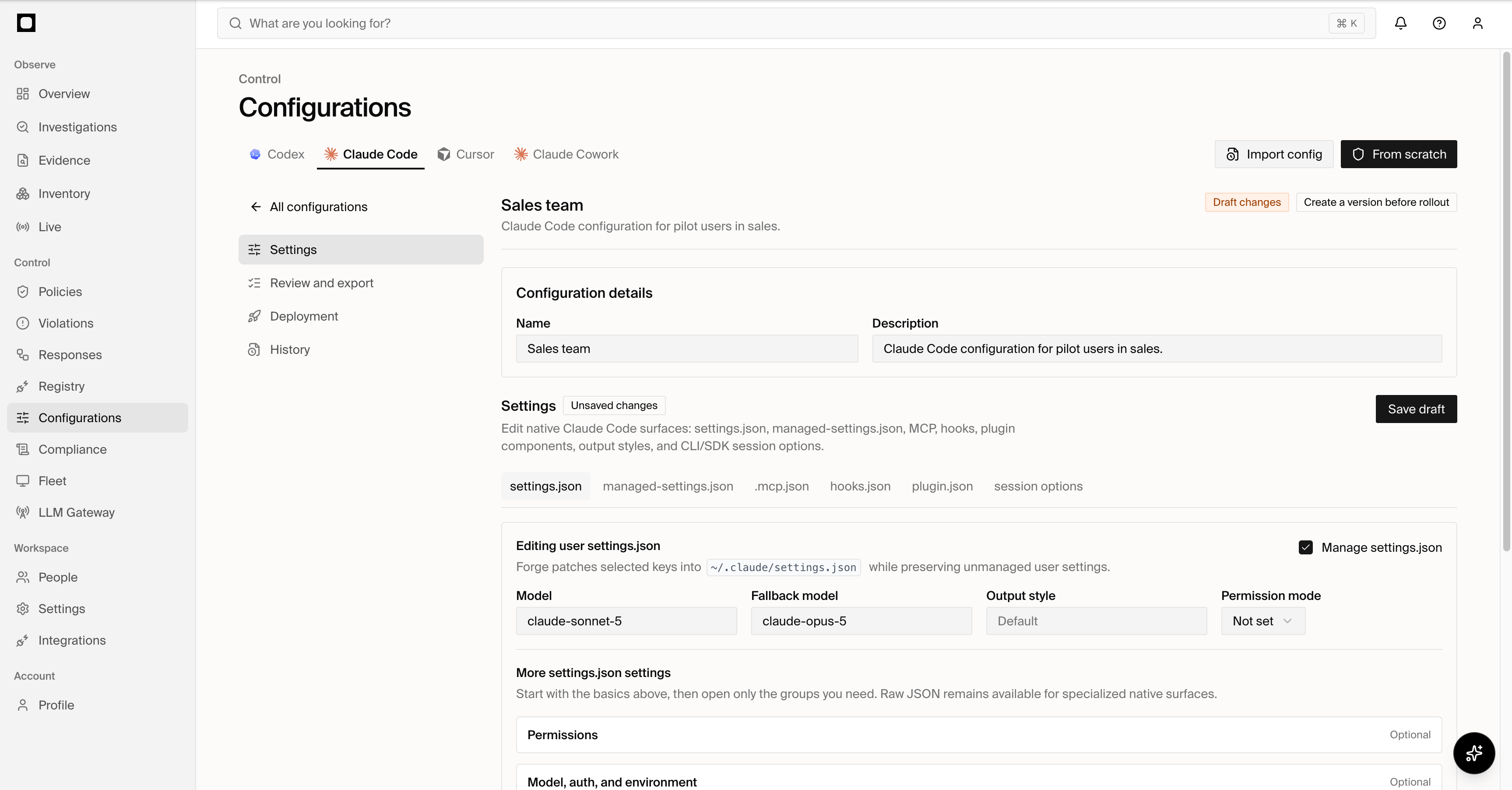
Configurations make it easy to define and roll out managed settings for AI agents across your organization, with assignments based on user, group, and agent. Forge gives security and platform teams one place to control approved models, tools, permissions, MCP servers, plugins, and other supported agent settings. Forge can also suggest improvements to managed configurations based on the real-world agent behavior it observes across your environment.
Forge configuration editor showing managed Claude Code settings, review, deployment, and history

Configurations

How it works

Profiles can be created in Forge or imported from an existing configuration. Publishing compiles the profile into the native configuration format required by the selected agent and deployment path.

Supported agents

Forge provides managed configuration workspaces for:
  • Codex
  • Claude Code
  • Cursor
  • Claude Cowork
Each agent exposes its own configuration capabilities. Forge presents only the settings and deployment methods supported by that agent family.

Managed settings

Depending on the agent, a profile can manage: The available fields are determined by the selected agent and configuration capability. Unsupported settings are not silently added to the generated configuration. Hooks shown in configuration or Inventory are native customer or product artifacts. Forge does not install endpoint hooks for traffic enforcement.

Deployment state

Forge retains the profile, assignment, release, deployment, and observed endpoint state separately. This makes it possible to see:
  • which release is assigned to each user, group, or agent;
  • where that release has been deployed;
  • the configuration currently observed on each endpoint;
  • whether the endpoint matches the assigned release;
  • deployment failures and configuration drift;
  • the complete release and deployment history.
Published releases are immutable. Updating a profile creates a new release, preserving the exact configuration previously deployed.

Deploy Codex on Windows

Forge can publish managed Codex settings to Windows devices through Microsoft Intune. Create or import a Codex profile, assign it to the intended users or devices, review the generated Windows configuration, and publish the release. Forge then follows the release from its Intune assignment through deployment and endpoint readback. The configuration view keeps each stage distinct: Published means the release is ready, Assigned means the management platform has received the targeting, Deployed means it reports a successful delivery, and Observed means Forge has read the configuration from the endpoint. A device is in drift when its observed settings do not match its assigned release. When you update a profile, publish a new release and deploy it to the same assignment. Forge preserves prior releases for review and rollback. Validation errors identify the setting that cannot be rendered for Windows before the release reaches devices; credentials and signing material are never shown in the rendered configuration.