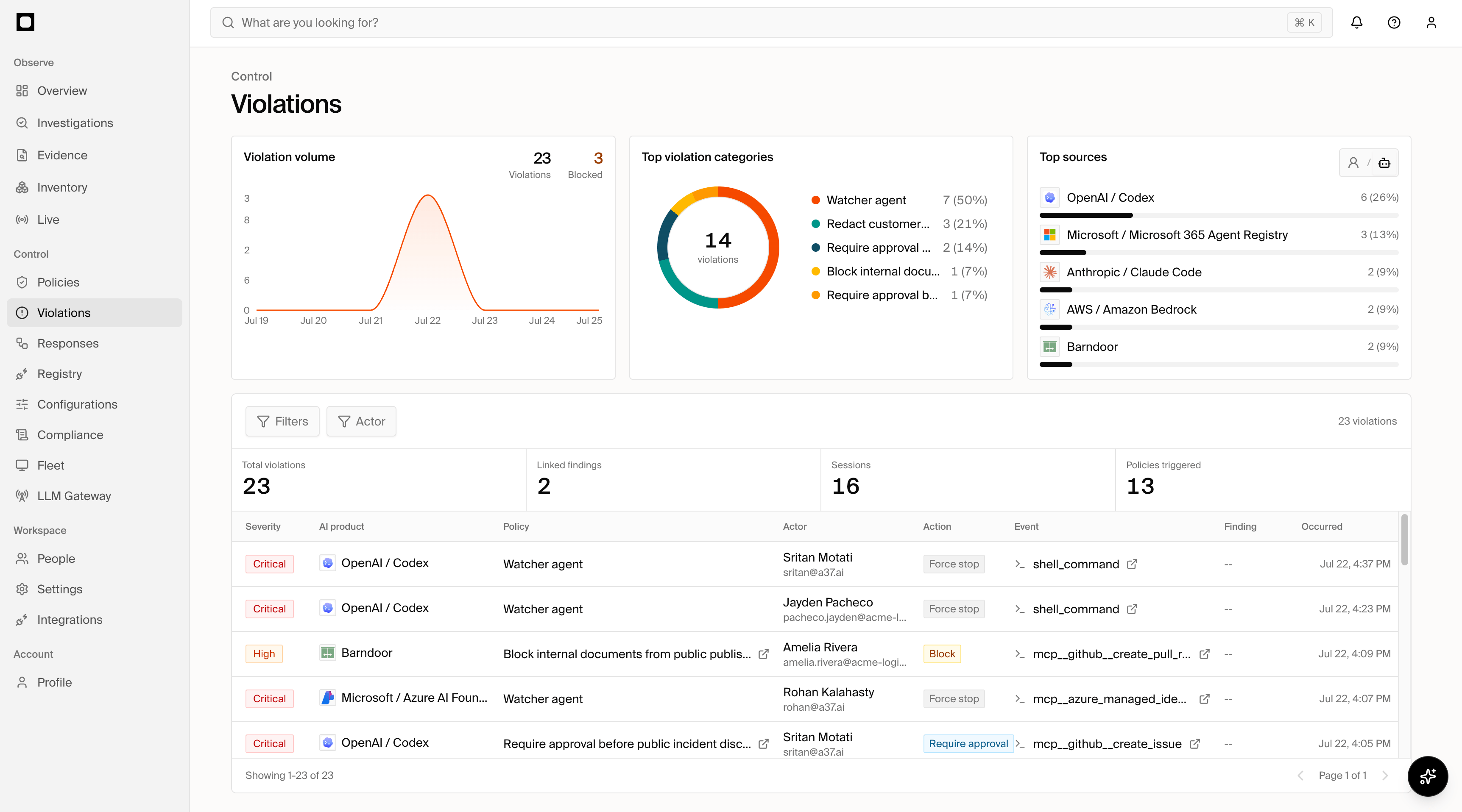
A violation is a durable occurrence created when a policy or governance evaluation produces an outcome configured to record a violation. It preserves the policy, triggering event, decision, enforcement result, and available evidence at the time of the occurrence. Not every policy evaluation creates a violation. Allowed activity and other non-violation outcomes can still appear in session telemetry without appearing here.
Forge Violations showing policy occurrences, actions, actors, events, findings, and summary metrics

Violations

Summary

The page summarizes the selected time window with:
  • Violation volume and the number of blocked outcomes.
  • Distribution by category.
  • Top AI systems or users.
  • Total occurrences, linked findings, affected sessions, and unique policies.
Chart distributions are calculated from the returned violation records. The table total and summary metrics represent the complete filtered result.

Records

Each row identifies: Filters include time range, policy source, outcome source, policy, action, severity, evidence availability, finding link, AI product, directory user, and device.

Details

Opening a violation shows the data available for that occurrence:
  • Policy, severity, action, AI product, actor, event time, enforcement method, and enforcement state.
  • The triggering content or action and a link to the exact session event when both identifiers are available.
  • Forge’s recorded explanation for why the violation was created.
  • Current event evidence and any earlier session evidence used by the governance decision.
  • Product, policy, runtime, account, and source-capability fields returned by the backend evaluation.
  • Nudge message or agent instruction when the policy decision included one.
  • A linked finding when another detection record is associated with the occurrence.
Evidence sections are omitted when the source did not provide that data. A violation without an exact session or event identifier cannot link directly to the triggering event.

Policy snapshots

Violation records retain hit-time policy identity and version information. The current policy may later be edited, disabled, or deleted; the violation still describes the policy and decision captured when the event occurred. Use Responses when the same governed activity created an approval decision, grant, or session intervention.