

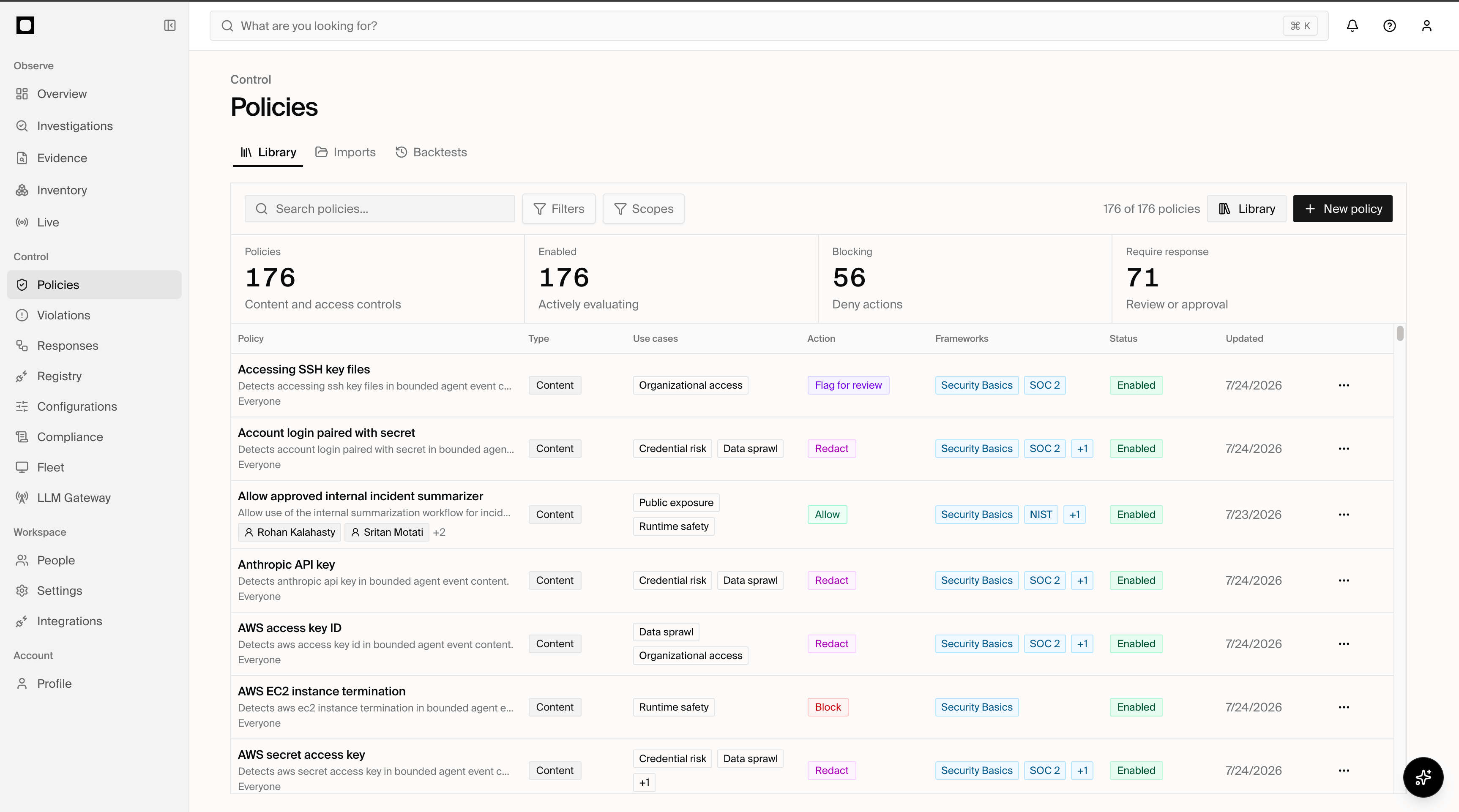
Policy library
Policy types
Forge has three organization-authored policy types:Content policies
Content policies evaluate the data and actions inside an AI workflow at one or more checkpoints:
Content policies can use identity, agent, product, model, MCP, classification,
tool input, tool result, and response context when the enforcing surface
provides it.
The
response checkpoint depends on the routed API surface and its response
adapter.
Access policies
Access policies govern the routes and software through which AI is reached. They can evaluate:- AI products and providers
- destinations and network routes
- processes and local runtimes
- browsers, extensions, and account posture
- users, groups, and devices
- source health and available enforcement capabilities
Resource policies
Resource Policies govern connections and protocol operations for configured HTTP, HTTPS, PostgreSQL, MySQL, and Redis Resources. They can scope by authenticated user, group, service account, device, and Resource; match supported HTTP request or PostgreSQL, MySQL, or Redis command facts; enforce or monitor; and return a clear policy message when an operation is blocked or needs approval. They can redact bounded HTTP JSON request and response bodies, filter HTTP response arrays, and redact or filter supported PostgreSQL and MySQL results before delivery. They are not a lightweight Access-policy mode. Resource is a complete third authoring family over the same condition, outcome, exception, revision, Rego, backtest, and ownership systems. Its own field and action catalog follows the capabilities of each protocol. Protocol data controls reuse existing transformation and approval machinery where the semantics match. Resource Policies apply to customer-deployed Resource Gateways and automatic endpoint routing through the same proxy path. See Resource policies for setup, credentials, supported protocol depth, and activity.Policy anatomy
Every policy contains:- A durable
id, display metadata, and enabled state. - A typed scope defining the identities and assets to which it applies.
- Native conditions or bounded Rego match logic.
- An optional exception tree that suppresses an otherwise valid match.
- A typed action such as
block,redact, orrequire_approval. - Family-specific configuration for evaluation points, transformations, approvals, runtime detection, notifications, or remediation.
Enforcement
Policy behavior depends on the capabilities of the surface evaluating it. A routed endpoint, network control, or gateway can stop a pending action; an observe-only source can record the same match but cannot retroactively prevent completed activity. Forge validates family, checkpoint, action, and remediation compatibility when the policy is saved.Author policies
Create, test, and verify Access, Content, and Resource policies in the
Console.
Policy use cases
Access, Content, and Resource policy use cases with setup, validation steps,
and evidence.
Linux access
Linux endpoint route support, caveats, and test commands.
Schema
Policy objects, scope, evaluation surfaces, and shared fields.
Conditions
Fields, operators, boolean logic, exceptions, and session history.
Actions
Exact outcomes, checkpoint constraints, defaults, and precedence.
Redaction
Redaction strategies, structured paths, and result filtering.
Remediation
Access-policy runtime behavior, surfaces, phases, and response actions.
Rego
Policy-as-code inputs, outputs, language limits, and validation.
Examples
Complete Access, Content, and Resource policy definitions.
Lifecycle
Revisions, ownership, backtests, deletion, and audit history.